If a client asks "how much per square metre for an extension?", a published benchmark can help with the first budget conversation. It cannot replace a quote built from drawings, specification, site conditions, and current local prices.
Turn the research into a real quote
Start with one live job, build the quote pack, and keep the costs tied to the price. No card required.
Build first quote freeCurrent Cost Per m² by Extension Type (UK, 2026)
| Benchmark | Published guide figure | Scope note |
|---|---|---|
| Full house extension | £1,800–£3,000/m² | Current FMB and Checkatrade national guidance |
| Shell-only extension | £1,200–£1,700/m² | Checkatrade benchmark for foundations, walls, and roof rather than a finished room |
| 20m² single-storey extension | £40,000–£56,000 | Checkatrade 2026 guide, excluding VAT |
| 60m² two-storey extension | £108,000–£180,000 | Checkatrade 2026 guide, excluding VAT |
| 40m² basement extension | £100,000–£160,000 | Checkatrade specialist-project benchmark |
Source note: these figures come from the linked FMB and Checkatrade guides accessed on 21 July 2026. Checkatrade describes its figures as ballpark averages and says its estimators include RICS and CIOB members. Do not combine rows as though their scopes are identical.
What's Included in These Figures?
A full-extension benchmark may cover:
- Groundworks and foundations
- Structural walls (brick or block)
- Roof structure and covering (flat EPDM or pitched tiles)
- Windows and external doors (uPVC)
- First fix electrics and plumbing
- Insulation and work needed to meet the applicable Building Regulations
- Plasterboard and skim
- Second fix electrics and plumbing
- Basic floor screed or timber floor
They typically exclude:
- Internal decoration and premium floor finishes
- Kitchen or bathroom supply and fitting
- Large-format glazing, roof lanterns, and premium doors
- Underfloor heating or changes to the existing heating system
- Design, planning, structural engineer, and Building Control fees
- VAT where the published figure is stated excluding VAT
Regional Price Variations
Published national averages should not be converted with a fixed regional multiplier. Checkatrade notes that London and the South East typically cost more, but the real difference depends on labour availability, logistics, specification, and the site. Build the quote from local subcontractor and supplier prices, then use the national range only as a sense-check.
What Pushes the Price Up?
The biggest drivers of cost above the base rate:
Turn the research into a real quote
Start with one live job, build the quote pack, and keep the costs tied to the price. No card required.
Build first quote free- Large glazing packages — Aluminium doors, roof lanterns, structural openings, and lifting requirements can materially change the price.
- Roof design — Span, falls, insulation build-up, drainage, rooflights, finishes, and interfaces with the existing building all affect cost.
- Underpinning existing foundations — If the existing structure needs strengthening, costs escalate rapidly. Always flag this as a provisional sum.
- Heritage properties — Listed-building or conservation constraints can require specific details, approvals, materials, and specialist labour.
- Tricky access — London side-returns in terraced rows, or rear extensions with no garden access, mean all materials come through the house. Price accordingly.
A Better Early Budget Check
For a 20m² single-storey extension, Checkatrade's June 2026 guide gives a ballpark range of £40,000–£56,000 excluding VAT. Use that only to test whether the client's budget and intended scope are in the same broad area. The next step is an itemised estimate based on the actual project.
How to Build an Accurate Extension Quote
Cost per m² is a starting point, not a quote. To protect your margin on extension work:
- Price each trade/section separately — don't lump everything into a single m² rate
- Get live material prices at the point of quoting — timber, blocks, and roof materials fluctuate
- State ground conditions and drainage assumptions, then add a separate risk allowance appropriate to what is still unknown
- Use a variation clause — any change to the agreed spec is a chargeable variation
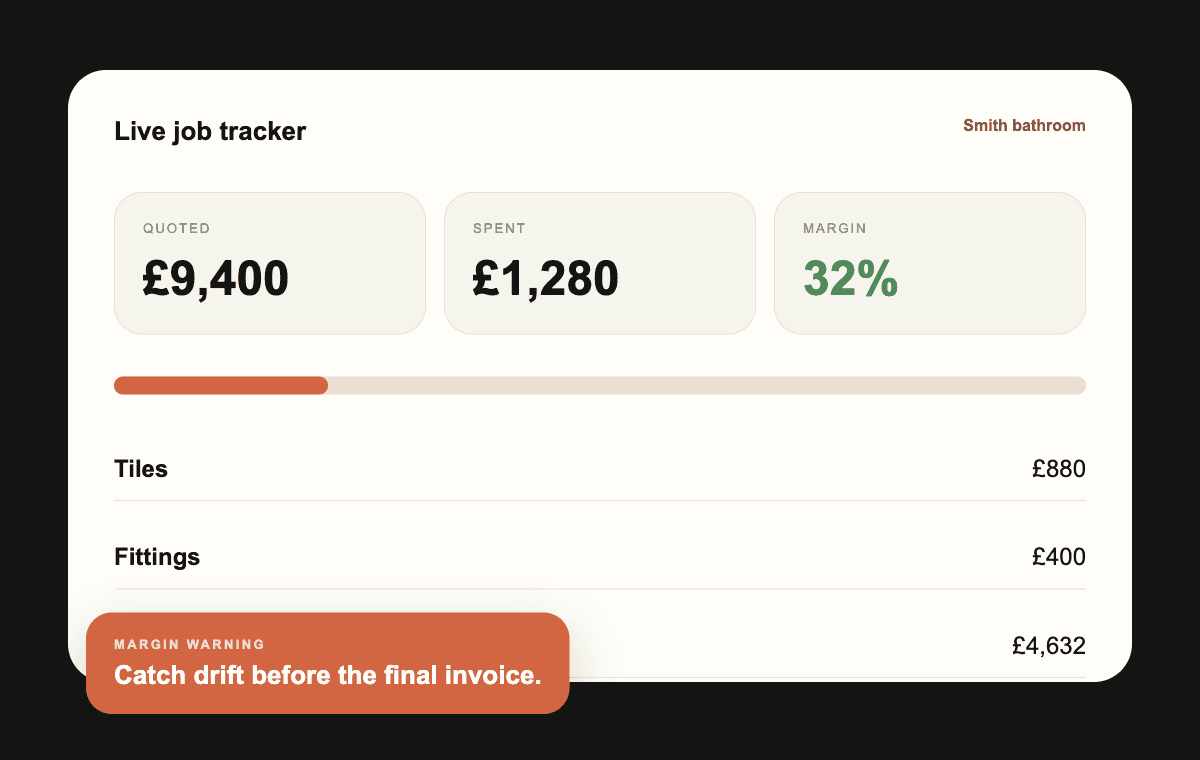
- Track actual costs weekly against your estimate as the job runs
QuoteBuild provides starting rates and supplier price checks for itemised extension quotes, then keeps recorded materials, labour, subcontractor costs, and variations connected to the accepted figure and live margin.
When the early budget check is done, use the free extension quote template for UK builders to turn the project into stages, assumptions, exclusions, payment milestones, and variation terms.
If extensions are part of your regular workload, see how live tracking works or check the flat pricing.
If you mainly quote builder projects, see the builder page or browse all trade pages.